The Narrator’s “Nevermore” Dialogue with the Raven
The RavenThe Narrator’s “Nevermore” Dialogue with the Raven is the central verbal event of the poem, transforming an encounter with a strange bird into an ordeal of grief, knowledge, and failed hope. The narrator begins by treating the Raven as an unintelligible visitor, but his questions progressively give the word “Nevermore” more authority until it seems to pronounce judgment on memory, consolation, reunion, and the possibility of escape.
Causes and Background
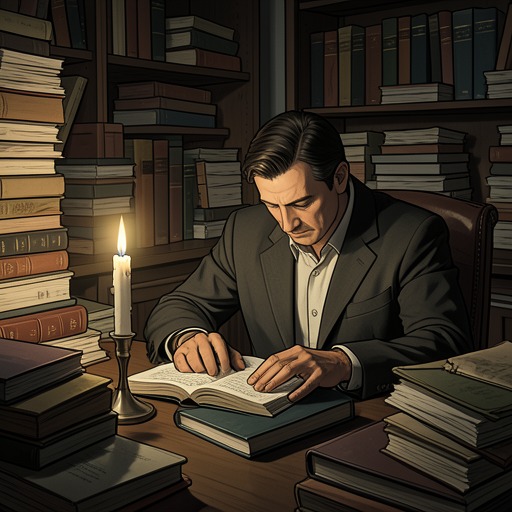
The dialogue grows out of the narrator’s mourning for Lenore. At midnight in bleak December, he has been reading forgotten lore while weak and weary, hoping that books might provide relief from sorrow for the lost Lenore, described as a rare and radiant maiden named by the Angels. The tapping at his chamber door first appears to be an ordinary late visitor, and the narrator repeatedly reassures himself that it is “nothing more.” This effort to impose a harmless explanation establishes the psychological pressure beneath the later questioning: the narrator wants both an interruption of grief and an explanation for it.
The Raven enters only after the narrator transfers the disturbance from the door to the window. In there steps a stately Raven of ancient, saintly days, which makes no obeisance and perches above the chamber door on a bust of Pallas. Its grave decorum briefly beguiles the narrator’s sad fancy into smiling. The bird is therefore presented in two opposed ways at once: it is an animal with an ungainly, nonhuman presence, yet it occupies a position associated with wisdom and speaks a human word. That contradiction makes the exchange possible without making the Raven fully intelligible.
Course of the Exchange
The narrator’s first question concerns the bird’s identity. Addressing it as a ghastly, grim, and ancient Raven wandering from the Night’s Plutonian shore, he asks for its lordly name. The Raven answers, “Nevermore.” At first, the response appears to have little meaning or relevancy. The narrator marvels that any bird or beast could discourse so plainly, while also recognizing that no ordinary creature would bear such a name. The word is initially treated as a learned response or a piece of the bird’s limited stock rather than as an oracle.
The Raven then sits lonely and speaks only that one word, as if its soul had been poured into it. Its silence between answers is as important as the answer itself: no further explanation, gesture, or flutter clarifies what “Nevermore” means. The narrator supplies the next question from his own fear, suggesting that other friends have flown before and that the bird will leave him on the morrow, just as his hopes have flown. The Raven repeats “Nevermore,” and a prediction of departure becomes an ominous confirmation that hope itself has already been lost.
As the exchange continues, the narrator changes from amused observer to desperate petitioner. He calls the Raven a prophet and a thing of evil, while leaving open whether it is a bird or devil, a Tempter sent to him or a creature tossed ashore by a tempest. The uncertainty surrounding the Raven’s nature does not diminish its authority; instead, it allows the narrator to address it as whatever power might answer questions that ordinary human beings cannot. The Raven’s fixed reply remains verbally narrow, but the narrator’s increasingly specific questions make its implications expand.
Grief, Consolation, and Repeated Denial
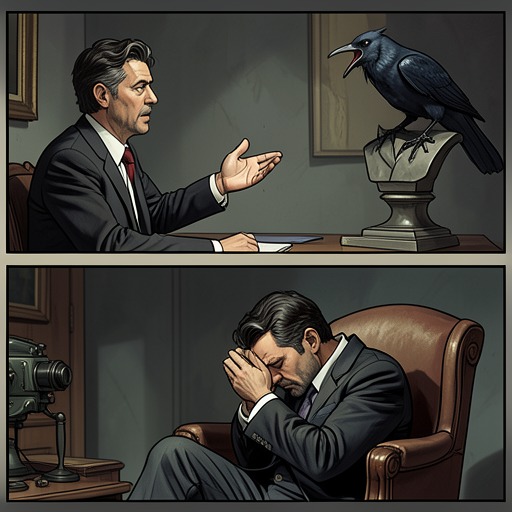
The dialogue reaches its emotional center when the narrator asks whether the Angels have sent respite and nepenthe, the forgetfulness promised by the imagined perfumed air and the unseen censer swung by Seraphim. He urges the Raven to quaff this kind nepenthe and forget the lost Lenore, but the Raven answers “Nevermore.” The answer rejects not only a literal remedy but also the possibility that memory can be dissolved. The narrator’s desire for relief is thus forced back upon the very loss he wishes to escape.
The next question shifts from forgetting to healing. Calling the Raven a prophet, whether bird or devil, the narrator asks, “Is there—is there balm in Gilead?” The repeated appeal for balm seeks a remedy for the soul’s wound, but “Nevermore” turns the question into an absolute denial. The exchange therefore moves through distinct forms of hope: immediate distraction, forgetfulness, and healing. Each is presented to the same one-word answer, and each successive refusal makes the narrator’s sorrow more definitive.
Finally, the narrator asks whether, within distant Aidenn, he will clasp the sainted maiden whom the Angels name Lenore. This is the most explicit question about reunion after death and the point at which the dialogue’s psychological stakes become unmistakable. The Raven again answers “Nevermore.” Because the narrator has framed the question as a direct appeal for truth, the repeated word now seems to confirm eternal separation, even though the text never supplies an independent basis for the Raven’s prophetic authority.
Conflict and Aftermath
The narrator eventually tries to terminate the conversation rather than interpret it. He declares that “Nevermore” should be their sign of parting and orders the bird to return to the tempest and the Night’s Plutonian shore. He demands that it take its beak from his heart and its form from his door, joining physical removal to emotional release. The command reveals that the Raven is no longer merely perched in the chamber: it has become an instrument of pain lodged within the narrator’s inner life.
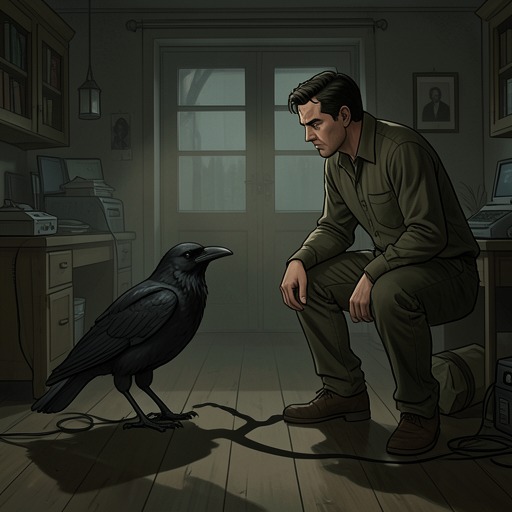
The Raven refuses the attempted banishment with one final “Nevermore.” It never flits away, but remains sitting on the pallid bust of Pallas above the chamber door. The repeated position fixes the word, the bird, and the threshold in a single tableau. What began with tapping and the narrator’s insistence on “nothing more” ends with an enduring presence that cannot be dismissed. The Raven’s eyes have the seeming of a demon dreaming, while lamplight throws its shadow across the floor; the narrator’s soul is consequently understood as caught within that shadow.
Narrative Significance
The dialogue’s decisive mechanism is repetition. “Nevermore” first functions as a name, then as an answer to anticipated departure, then as a refusal of nepenthe, a denial of balm in Gilead, and finally a rejection of reunion with Lenore. The Raven does not visibly develop an argument; the narrator’s questions develop the word for it. Meaning accumulates through the collision between open, urgent human questions and a single closed response.
The exchange also sustains a tension between natural and supernatural explanations. The Raven may be a trained bird repeating a phrase learned from an unhappy master, yet the narrator addresses it as prophet, devil, or messenger from a Plutonian shore. Nothing in the bird’s conduct resolves the uncertainty. Its animality remains visible in its ungainly form and restricted speech, while its placement above Pallas and its apparently absolute answer give it an authority beyond ordinary nature.
The event therefore dramatizes the narrator’s movement from mourning toward psychological entrapment rather than recovery. His first attempts to control the scene depend on repetition: the visitor is “nothing more,” the late visitor is harmless, and the disturbance has a simple explanation. Once the Raven answers, however, repetition no longer reassures him. It returns the same word with increasing force until every imagined route out of grief is closed. The Raven’s refusal to leave makes that closure permanent in the poem’s final image: the bird remains above the door, and the narrator’s soul remains under its shadow.